The AI-native Rails 8 foundation
Everyone's building. You'll be selling.
Ship this weekend.
The boring 90% of every SaaS — auth, billing, admin, deploys — already working, tested, and documented so your AI agent builds on it instead of reinventing it. You and your agent start at your product.
One-time payment · 12 months of updates · Unlimited projects · This page runs on Uno
01 / The problem
Even with AI, the first weeks of every SaaS are the same.
Prompt, review, debug, harden — weeks of plumbing before your first real feature. None of it is your product.
AI made writing code cheap. It didn't make being wrong cheap.
Uno ships the parts you can't vibe-check — tested, documented, extracted from production apps. You start at the interesting part.
02 / The shortcut
Claude Code can generate all of this. So why buy it?
Because generating code was never the expensive part — reviewing it is. Auth, billing, encryption: weeks to verify, one missed edge case to regret.
Uno is that verification already done. Your agent starts from code that's already right — and every prompt lands on documented conventions instead of guesses. You skip the review debt, not just the typing.
The stack under the hood — no Redis, no Node, nothing extra to babysit.
Rails 8.1Ruby 4.0PostgreSQLSolid Queue / Cache / CableHotwirePhlex 2Tailwind 4DaisyUI 5BunRails Event StoreStripeFlipperKamal 2why this stack →03 / What's inside
Everything already wired.
Not stubs, not TODOs — working features extracted from production apps, each with its own documentation.
Auth, every flavor
Magic links, one-time codes, Google & Apple, classic Devise, JWT rotation for the API. The flow every SaaS needs and nobody enjoys hardening — your users just sign in, from day one.
Stripe billing, wired
Checkout, customer portal, webhook handling, purchase models, plan resets. Connect your keys and charge real money the day you launch.
Full admin panel
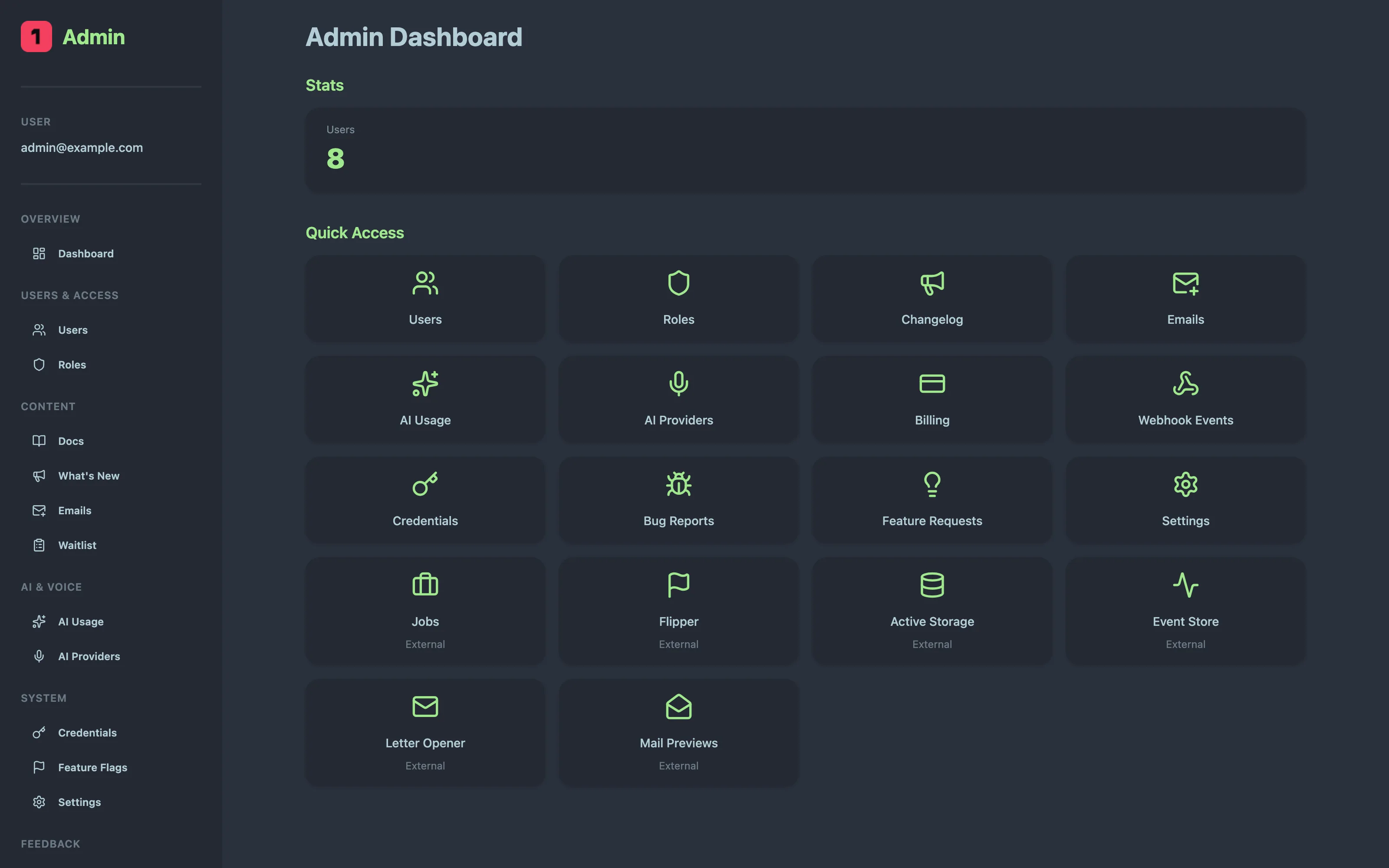
Impersonation, roles with audit history, feature flags, moderation, changelog, and a Cmd+K palette. Support your first customer the day they arrive — without building a single view.
Background jobs, no Redis
Solid Queue with the Mission Control dashboard at /jobs. Emails send, retries happen, and you can watch all of it — with zero extra infrastructure.
Email, push, Slack, realtime
Transactional email, FCM push, ActionCable realtime, and Slack alerts via Noticed — each behind a kill switch. Reach users wherever they are; turn any channel off in one click.
End-to-end encrypted API
Envelope encryption for mobile payloads, encrypted columns, rate limiting. User data that survives a security review — and a breach headline you never write.
Every state change on record
Rails Event Store captures every state change as a replayable fact. When a customer says 'you charged me twice,' you show exactly what happened — full audit trail at /res.
Architecture that scales
Domain contexts, application services, documented conventions for every layer. Feature #50 lands as easily as feature #5 — the big rewrite never comes.
Deploy on day one
Kamal 2 + Docker + Thruster. One command from laptop to production — SSL, CDN, object storage — on a $6/month VPS you own.
Fast by default
Solid Cache, immutable assets, stale-while-revalidate, and N+1 detection that fails the build. Pages stay fast without you ever opening a profiler.
AI infrastructure ready
Multi-provider LLM clients, usage logging, an audit trail for every call, and a tool-calling agent framework. Ship your AI feature this week — and swap providers without a rewrite.
Mobile from the same codebase
Hotwire Native iOS shell, installable PWA, offline-sync API reference. Your web app becomes an App Store app — no second codebase, no second team.
04 / Architecture
Vibe-coded apps stall at the demo. This one scales.
Quick AI generation gets you a prototype — then the wall: tangled controllers, no boundaries, every feature harder than the last, until the rewrite. Uno hands you the architecture enterprise SaaS run on — already designed, already wired, already documented. You inherit the durability, not the complexity, and the code still makes sense at feature #50.
- Every state change is a fact you can replay — disputes end with evidence, not archaeology (Rails Event Store)
- One entry point per use case — no fat controllers to untangle later (application services on dry-rb)
- Queries stay fast as data grows — denormalized read models instead of report-page rescue missions (CQRS)
- A safety net on every change: integration tests, factories, VCR — and an N+1 guard that fails the build
- Views that read and refactor like plain Ruby — and cost your agent a fraction of the tokens (Phlex)
- Boundaries that keep AI agents productive at feature #50 — structure isn't just for humans
class ActivateSubscription < ApplicationService
  def call(command)
    subscription = yield find(command.id)
    yield activate(subscription)

    publish(SubscriptionActivated.new(
      subscription_id: subscription.id
    ))

    Success(subscription)
  end
end
05 / Built for AI agents
The codebase your agent wishes you had.
Everyone has the same AI tools now. Pointed at a vibe-coded prototype, they compound the mess. Pointed at Uno, every prompt lands on architecture built to scale.
AGENTS.md + 40 per-feature docs
Your agent reads the manual and ships in one pass — no archaeology, no guessing.
Phlex views are pure Ruby
Your agent edits them accurately — pure Ruby, no template dialect — and burns a fraction of the tokens ERB does.
Documented conventions for every layer
The agent follows the paved road instead of inventing structure at 2am.
A test suite that reviews your agent
Integration tests, factories, and an N+1 guard that fails the build before slop ships.
06 / Back office
The admin panel alone would cost more to build than all of Uno.
The weeks of internal tooling you'd never bill anyone for — done. Day one, you support users, flip features, watch jobs, and audit everything.
One-time payment · Ship this weekend

Hey, I'm Rafał.
I ship production Rails apps for a living. Uno is that experience condensed — every convention in it earned its place in production work, the hard way. Now I'm building my own products on it, in public: my apps run on this exact code, so fixes and features land the moment a real app needs them. If Uno breaks, my products break first. That's the warranty.
07 / Pricing
Pay once. Ship forever.
Launch pricing. Each card shows today's price — and the rung it rises to next.
Starter
- The complete system — every feature above
- 40+ per-feature docs
- Unlimited projects
- 12 months of new releases
- Server setup & security guide
- AI workflow guide
- Video walkthroughs
- Priority support
Pay once. Build unlimited projects.
Complete
- Everything in Starter
- Server setup & security guide: Hetzner VPS, Kamal deploy, hardening
- AI workflow guide — how to build on Uno with your agent
- Short video course: from clone to productionComing soon
- Priority support
Pay once. Build unlimited projects.
Instant delivery · Secure checkout · Final sale after access — you'll accept the Terms at checkout
What is Uno?
Uno is a one-time-purchase Rails 8 SaaS starter template built for AI coding agents. It ships auth, Stripe billing, an admin panel, background jobs, notifications, event sourcing, an encrypted API, and Kamal deployment — on Rails 8.1, Hotwire, Phlex 2, and PostgreSQL only (no Redis, no Node runtime in production). It includes AGENTS.md and 40+ per-feature docs so agents like Claude Code and Cursor follow its conventions.
08 / FAQ
Everything you'd ask before buying.
Why not just have Claude Code generate all of this?
It can — and you'll spend weeks reviewing, hardening, and re-prompting what Uno already ships tested. Auth, billing, and encryption are the parts you can't vibe-check. Uno is that verification already done, plus the conventions and docs that make your agent's output production-grade from the first prompt.
Isn't a vibe-coded MVP enough?
To demo an idea — yes. To run a real SaaS — no. Vibe-coded apps have no boundaries, no audit trail, no test suite, and every new feature makes the next one harder until the rewrite. Uno starts you on the architecture enterprise SaaS run on — without you designing any of it — so the prototype you ship this weekend is the same app you scale for years.
Isn't this architecture overkill for an MVP?
For a throwaway demo — yes. For a product you intend to run — it's the point. You don't design any of it: the conventions and docs do the heavy lifting, your agent follows the paved road, and features you don't need switch off with a flag or delete cleanly. Uno is for people who value quality — the MVP you ship this weekend is already the app you'll scale, so the rewrite never comes.
What exactly do I get?
The complete Rails application as a versioned archive, downloaded from your customer portal right after purchase — plus 40+ per-feature docs and updates. Extract it, run bin/setup, and start building your product on top.
Is the video course available yet?
Not yet — it's marked "Coming soon" on the Complete card for that reason, and it's the only thing on either card that isn't written yet. Everything else ships the moment you buy: both tiers get the full codebase and 40+ per-feature docs, and Complete also gets the server setup and security guide (Hetzner VPS, hardening, Kamal deploy) and the AI workflow guide today. The course is recorded and published to your customer portal within your update window, at no extra cost. If the guides, course, and priority support don't matter to you, buy Starter. I'd rather you paid for what exists today.
What's the tech stack?
Rails 8.1 on Ruby 4.0, Hotwire, Phlex 2 views, Tailwind 4 with DaisyUI 5, Bun for JS, Stripe, Rails Event Store, and Kamal 2 for deploys. PostgreSQL is the only datastore — cache, jobs, websockets, and events all run on Postgres. No Redis, no Node runtime in production, one cheap server.
How many projects can I build with it?
Unlimited personal and commercial projects. The only thing you can't do is resell or redistribute the template itself.
Does it work with Claude Code and Cursor?
It's built for AI-assisted coding: AGENTS.md, documented conventions for every layer, and Phlex views that are pure Ruby — far more token-efficient than ERB/HTML for coding agents.
Why Phlex instead of ERB?
Views are plain Ruby objects: componentized, testable, fast, and refactorable with the same tools as the rest of your code. And AI agents read and write them with far fewer tokens.
Do I need to be a Rails expert?
No. If you're comfortable with Rails basics you can ship with this. Every feature has its own doc explaining what it does, where it lives, and how to extend it.
How do I get updates?
New releases are published to your customer portal — download them whenever you like. Every purchase includes 12 months of new releases, and you keep lifetime access to every version you've received.
What other costs should I expect?
A VPS from ~$6/month (Kamal deploys to any box), a domain, and Stripe's standard fees. No mandatory third-party SaaS subscriptions — jobs, cache, and websockets all run on Postgres.
Is there a refund policy?
No — and that's deliberate. You receive the entire codebase the moment you pay, so it can't be returned; the FAQ, docs list, and feature tour above show you exactly what you're buying. You accept our Terms (including waiving the statutory 14-day withdrawal right) before checkout. Mandatory consumer rights still apply where the law requires.
Can I remove features I don't need?
Yes. Features are isolated in domain contexts under app/core and gated with Flipper flags — switch them off or delete the folder cleanly.
I already started building my app. Can I still use Uno?
Yes — two ways. Port your existing features into Uno (usually faster: the plumbing is done), or copy individual features out of Uno into your app; each one is isolated in a domain context with its own doc.
How often is Uno updated?
Continuously — it's the base for every product I ship, so fixes and features land as real apps need them. Every purchase includes 12 months of new releases, and you keep lifetime access to every version you've received.
Ship before your competitors
finish reviewing their AI's auth code.
Everyone prompts. Few start from a production-proven foundation that scales. Every week you spend rebuilding auth is a week your competitors spend on their product. One weekend to launch — your idea deserves the head start.
One-time payment · 12 months of updates · Terms apply before checkout